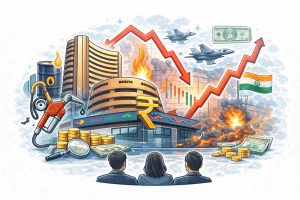
Indian equity markets have entered February 2026 on an unusually volatile footing, with sharp intraday swings becoming the norm rather than the exception. The turbulence is not being driven by a single shock but by a convergence of domestic policy recalibration, global risk sentiment shifts, and structural changes in how India’s markets now function. Together, these forces have created an environment where prices react faster, moves are magnified, and investor confidence is repeatedly tested.
The most immediate trigger for volatility this month has been the Union Budget 2026. As is often the case, the Budget acted as a catalyst for large-scale repricing across sectors, with investors reassessing expectations around government spending, taxation, and fiscal discipline. In February 2026, that reassessment has been particularly sharp because markets entered the Budget period with elevated expectations and rich valuations in several segments. When policy signals did not uniformly align with optimistic assumptions, equities responded with swift declines and wide trading ranges. Such reactions reflect not panic, but the speed at which modern markets process and discount new information.
Compounding the Budget impact has been the growing influence of derivatives on daily market behaviour. India’s equity markets have seen a rapid rise in futures and options participation over the past few years, especially among retail traders and proprietary desks. In February, adjustments related to transaction costs and regulatory oversight have made derivatives positioning more sensitive. When large volumes of index-linked contracts are unwound or hedged simultaneously, even modest news flows can trigger exaggerated price movements. This structural factor has made volatility more persistent, as swings are reinforced by mechanical trading responses rather than purely by long-term investment decisions.
Monetary policy expectations have added another layer of uncertainty. The Reserve Bank of India’s decision to hold interest rates steady has removed the immediate risk of a surprise move, but it has not eliminated debate about the future policy path. Investors remain alert to inflation trends, commodity price risks, and growth signals, all of which could influence upcoming decisions. In such a pause phase, markets tend to oscillate as participants alternate between optimism about stable rates and concern about what might eventually force a change. This constant recalibration keeps sentiment fragile and trading ranges wide.
Currency and capital flow dynamics have further contributed to the choppiness. The rupee has shown relative resilience even as equities have faced bouts of selling, creating mixed signals for investors trying to gauge the true direction of foreign participation. On some days, overseas investors have reduced equity exposure while currency markets remained calm, suggesting hedging activity rather than outright capital flight. This divergence has added to uncertainty, as traders struggle to determine whether sell-offs are temporary adjustments or the start of a more sustained shift in global allocation.
Global factors have also played a decisive role in amplifying volatility. Movements in global bond yields, shifting expectations around monetary policy in advanced economies, and intermittent risk-off sentiment have spilled over into Indian markets. As India becomes more deeply integrated into global portfolios, its indices react more quickly to international cues. Even when domestic fundamentals remain stable, global uncertainty can trigger sudden sector rotations and index-level swings.
Sector-specific pressures, particularly in information technology, have intensified the volatility. IT stocks have faced renewed scrutiny as investors reassess global demand conditions and the longer-term impact of rapid technological change. Concerns around pricing power, client spending patterns, and competitive pressures have led to sharp moves in IT counters, which carry significant weight in benchmark indices. These sectoral adjustments have contributed to broader market fluctuations, even on days when other parts of the market appear relatively stable.
February has also compressed multiple high-impact events into a short time frame. The combination of Budget fallout, central bank decisions, and a busy corporate earnings calendar has kept markets in a near-constant state of anticipation. When several known events cluster together, investors often reduce exposure ahead of announcements and re-enter positions quickly afterward. This pattern leads to abrupt reversals, as markets swing between caution and relief within the same trading session.
Psychology has played an understated but critical role as well. Sharp moves early in the month have made investors more defensive, encouraging quicker profit-taking and a lower tolerance for uncertainty. Rallies have struggled to sustain momentum as traders remain wary of sudden reversals, while declines have been punctuated by short-covering rather than confident buying. This behaviour reinforces volatility, as markets lack the steady conviction needed for smoother trends.
Taken together, the volatility seen in Indian markets in February 2026 reflects a complex interplay of policy reassessment, market structure evolution, global influences, and investor psychology. Until the implications of the Budget are fully absorbed, earnings visibility improves, and global risk sentiment stabilises, large swings are likely to persist. For now, February stands out as a reminder that India’s markets, while fundamentally robust, are increasingly fast-moving and sensitive to both domestic and global signals.
Disclaimer: The information presented in this article is intended for general informational purposes only. While every effort is made to ensure accuracy, completeness, and timeliness, data such as prices, market figures, government notifications, weather updates, holiday announcements, and public advisories are subject to change and may vary based on location and official revisions. Readers are strongly encouraged to verify details from relevant official sources before making financial, investment, career, travel, or personal decisions. This publication does not provide financial, investment, legal, or professional advice and shall not be held liable for any losses, damages, or actions taken in reliance on the information provided.
Financial Disclaimer: Markets and investment-related products are subject to risks and fluctuations. Readers should conduct their own research and consider consulting a qualified financial advisor before making any investment decisions.
Last Updated on: Friday, February 6, 2026 3:15 pm by Business Byte Team | Published by: Business Byte Team on Friday, February 6, 2026 3:15 pm | News Categories: Trending, Economy, GENERAL
About Author