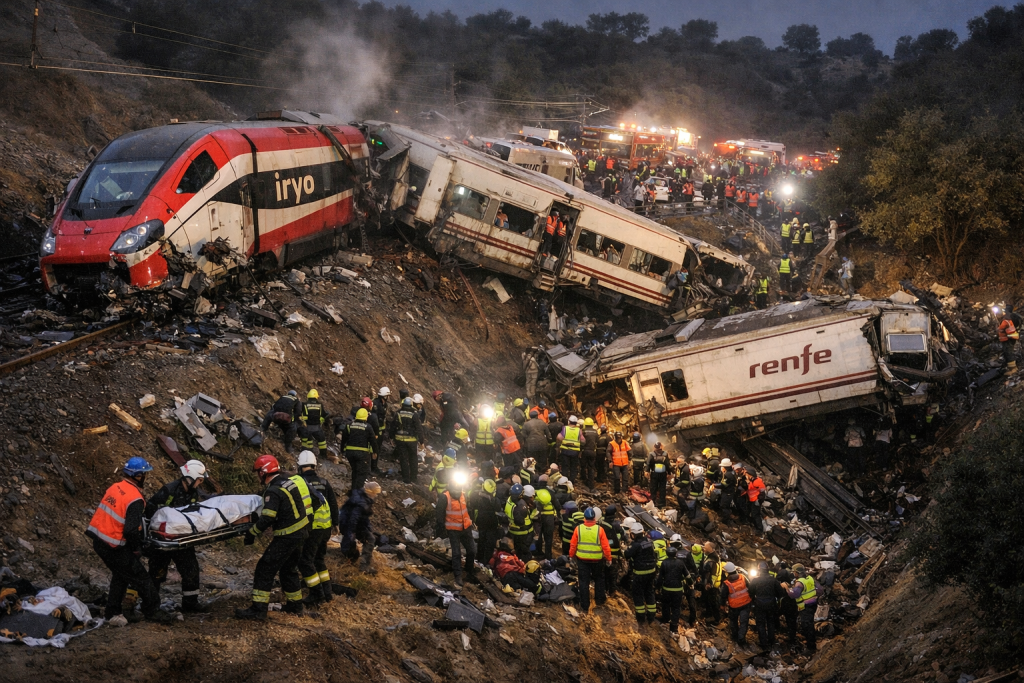
Adamuz, Spain — 19 January 2026: A catastrophic accident involving two high-speed trains has left at least 39 people dead and hundreds injured in one of the worst rail disasters in Spain in more than a decade. The crash occurred late on Sunday evening near the town of Adamuz in Córdoba province, in southern Spain, when an Iryo high-speed train derailed and collided with an oncoming Renfe service.
What Happened
At around 7:39 p.m. local time on 18 January, an Iryo train travelling from Málaga to Madrid suddenly derailed while running on a straight, recently upgraded section of track near Adamuz. The derailment caused the train to cross onto the adjacent track, where it struck an oncoming Renfe Alvia train bound from Madrid to Huelva.
The impact was devastating. Several carriages overturned, and parts of the Renfe train were pushed down a 4-metre embankment, concentrating fatalities in the front cars.
Casualties and Rescue Efforts
- Deaths: At least 39 people confirmed dead by authorities, with fears the toll may rise as recovery operations continue.
- Injuries: More than 150 people injured, including dozens in serious or critical condition.
- Emergency teams from the Spanish Civil Guard, Red Cross, and regional services are working around the clock to retrieve victims and treat survivors amid twisted wreckage.
Local residents and passengers described chaotic scenes as people used emergency tools and broke windows to escape trapped carriages.
Official Responses
Spain’s Prime Minister Pedro Sánchez expressed profound sorrow and declared national mourning, cancelling scheduled engagements to oversee the response.
Transport Minister Óscar Puente called the accident “extremely strange,” noting that the derailment occurred on a flat stretch of track that had been refurbished recently and was supposed to be in excellent condition. He warned that a full investigation could take weeks or longer.
Meanwhile, authorities have suspended all high-speed rail services between Madrid and Andalucía as safety checks and forensic work continue.
Investigation Underway
Rail safety experts, state investigators, and ADIF — Spain’s rail infrastructure manager — are combing the accident site for evidence. Initial questions focus on why a modern high-speed train derailed on a straight, upgraded section of track — a scenario that specialists describe as “very difficult to explain.”
Officials are reviewing data from onboard systems, track sensors, and maintenance logs while examining mechanical and infrastructure factors. DNA and forensic teams are assisting with the identification of victims.
Historical Context
Spain’s high-speed rail network (AVE and private operators like Iryo) is among the most extensive in Europe, with over 3,000 km of dedicated tracks and a strong safety record since its inception in the early 1990s.
The Adamuz crash is the deadliest rail accident in Spain since the 2013 Galicia derailment, which killed 80 people and deeply impacted public confidence in rail safety.
Impact on Rail Services
Disruptions are widespread across long-distance corridors connecting southern Spain with Madrid and other major cities. Hundreds of services have been cancelled or delayed as emergency and inspection work continues, and passengers are advised to check with rail operators before travelling.
Moving Forward
Authorities have pledged transparency and a rigorous investigation to determine the root cause of the derailment and prevent future tragedies. The accident has reignited debate in Spain about rail safety, infrastructure investment, and emergency preparedness — particularly for high-speed networks that carry millions of passengers annually.
Also Read : Wipro Share Price Tanks Nearly 10% After Q3 FY26 Results
Follow us also on : Click here
Last Updated on: Monday, January 19, 2026 4:39 pm by Praneetha Kattamidi | Published by: Praneetha Kattamidi on Monday, January 19, 2026 4:39 pm | News Categories: Startups
About Author