
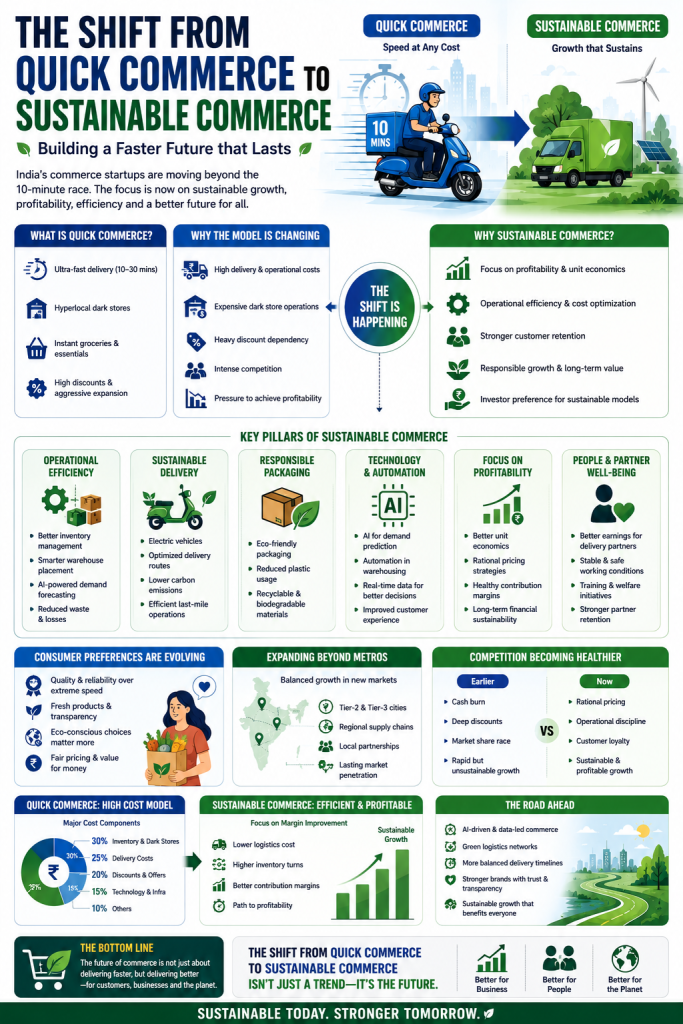
India’s retail and startup ecosystem is witnessing a major strategic transformation as businesses increasingly focus on long-term sustainability instead of ultra-fast delivery expansion. The growing shift from quick commerce to sustainable commerce reflects changing investor expectations, profitability concerns, and evolving consumer behavior.
Quick commerce platforms once prioritized 10-minute deliveries, aggressive expansion, and deep discounting to capture market share. However, rising operational costs and profitability pressure are now pushing companies toward more sustainable business models focused on efficiency, customer retention, and responsible growth.
Industry experts believe this transition could redefine the future of India’s digital commerce industry.
What Is Quick Commerce?
The discussion around the shift from quick commerce to sustainable commerce begins with understanding how quick commerce transformed online retail.
Quick commerce platforms specialize in:
- Ultra-fast grocery delivery
- Instant household product delivery
- Hyperlocal fulfillment systems
The model gained massive popularity during and after the pandemic as consumers increasingly preferred convenience and rapid delivery services.
Why the Business Model Is Changing
The growing shift from quick commerce to sustainable commerce is largely driven by financial and operational realities.
Major challenges faced by quick commerce companies include:
- High delivery costs
- Expensive dark store operations
- Heavy discount dependency
- Rising competition
Many companies realized that rapid growth without sustainable profits could become difficult to maintain long term.
Investors Now Want Profitability
One of the biggest reasons behind the shift from quick commerce to sustainable commerce is changing investor sentiment.
Venture capital firms are increasingly prioritizing:
- Profitability
- Strong unit economics
- Sustainable customer acquisition
- Efficient logistics operations
Startups are now under pressure to prove they can build financially stable businesses rather than focusing purely on rapid expansion.
Focus Shifting Toward Operational Efficiency
The shift from quick commerce to sustainable commerce is encouraging companies to optimize operations more carefully.
Businesses are now focusing on:
- Better inventory management
- Reduced delivery losses
- Smarter warehouse placement
- AI-powered demand forecasting
Companies are trying to improve margins instead of relying heavily on continuous funding support.
Consumer Behavior Is Also Evolving
Changing consumer preferences are contributing to the shift from quick commerce to sustainable commerce.
Many customers now value:
- Reliable service quality
- Product freshness
- Eco-friendly packaging
- Fair pricing over extreme speed
While instant delivery remains attractive, consumers are increasingly supporting brands that demonstrate responsibility and consistency.
Sustainability Becoming a Competitive Advantage
The shift from quick commerce to sustainable commerce is also linked to growing environmental awareness.
Companies are now exploring:
- Electric delivery vehicles
- Sustainable packaging
- Reduced carbon emissions
- Optimized logistics routes
Experts believe sustainability could become a major competitive advantage in the future retail market.
AI and Automation Supporting the Transition
Technology is playing a key role in the shift from quick commerce to sustainable commerce.
AI-powered systems are helping businesses:
- Predict customer demand
- Optimize delivery routes
- Reduce waste
- Improve inventory efficiency
Automation is helping companies reduce operational costs while maintaining customer satisfaction.
Smaller Cities Driving New Opportunities
The shift from quick commerce to sustainable commerce is also influencing expansion strategies.
Instead of focusing only on metro cities, companies are increasingly exploring:
- Tier-2 cities
- Tier-3 markets
- Regional supply chain optimization
Businesses are aiming for balanced growth instead of expensive hyper-expansion.
Competition Is Becoming More Balanced
The rapid expansion phase of quick commerce created intense competition and cash-burning strategies.
Now, the shift from quick commerce to sustainable commerce is encouraging healthier market dynamics through:
- Rational pricing
- Better operational planning
- Sustainable customer acquisition strategies
Experts say this could create stronger long-term businesses.
Impact on Delivery Workforce
The shift from quick commerce to sustainable commerce may also improve working conditions within the gig economy.
Companies focusing on sustainability may invest more in:
- Delivery partner welfare
- Stable operational planning
- Reduced delivery pressure
This could help improve workforce retention and efficiency.
Future of India’s Commerce Ecosystem
Industry analysts believe the shift from quick commerce to sustainable commerce will continue shaping India’s retail sector over the next few years.
Future trends may include:
- AI-driven commerce operations
- Green logistics networks
- More balanced delivery timelines
- Improved profitability models
Companies capable of combining convenience with sustainability may emerge as long-term market leaders.
Global Trends Influencing India
The shift from quick commerce to sustainable commerce is not limited to India alone.
Globally, investors and consumers are increasingly favoring:
- Responsible growth strategies
- Sustainable supply chains
- Environmentally conscious operations
Indian startups are adapting to these global expectations as competition intensifies.
Conclusion
The growing shift from quick commerce to sustainable commerce reflects a deeper transformation within India’s startup and retail ecosystem. As companies move beyond aggressive expansion and focus more on profitability, efficiency, and sustainability, the future of digital commerce may become more balanced and resilient.
While quick delivery convenience is likely to remain important, sustainable growth strategies could ultimately determine which companies survive and lead the next phase of India’s commerce revolution.
Also read: Powerful Partnership: IndiaAI Healthcare AI Adoption Gets Major Boost Through ICMR Collaboration
Add Business Byte as a preferred source on Google- Click Here
Last Updated on: Friday, May 15, 2026 11:46 pm by Lakshmi Tejasri | Published by: Lakshmi Tejasri on Friday, May 15, 2026 11:46 pm | News Categories: Tech
About Author