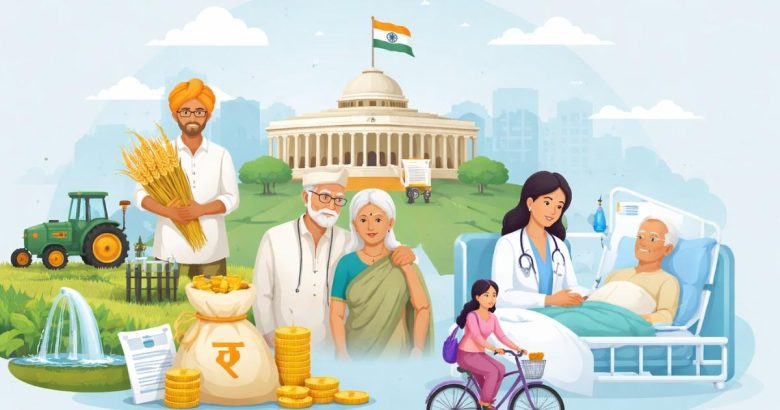
The Government of India has announced a series of updates to its flagship welfare and development schemes for 2026, signalling a renewed focus on inclusive growth, social protection, and improved access to public services. The changes, introduced through the Union Budget 2026–27 and subsequent policy notifications, include expanded eligibility criteria, enhanced financial benefits, and broader coverage across healthcare, agriculture, senior welfare, and rural development.
A major highlight of the 2026 updates is the expansion of public healthcare coverage under the Ayushman Bharat framework. The government has widened eligibility to include all senior citizens aged 70 years and above, regardless of income status. This move significantly broadens the scope of the programme, which previously prioritised economically vulnerable households. Under the revised framework, eligible beneficiaries continue to receive health insurance coverage of up to ₹5 lakh per family per year for secondary and tertiary hospitalisation. Officials say the expansion is intended to address rising healthcare costs for the elderly and ensure that age-related medical needs do not translate into financial hardship.
The Union Budget 2026 has also introduced several new initiatives aimed at strengthening rural incomes and agricultural resilience. Among them is a technology-driven advisory platform designed to provide farmers with region-specific guidance on crops, weather conditions, soil health, and market access. Alongside this, the government has announced a renewed push for water conservation and irrigation infrastructure through expanded reservoir development and rural water management projects. These measures are expected to improve farm productivity while supporting allied activities such as fisheries and livestock.
Employment generation and skill development remain central pillars of the government’s welfare strategy in 2026. Budget allocations indicate increased support for training programmes aligned with emerging sectors, including manufacturing, logistics, and digital services. The focus has shifted toward employability and long-term income stability, particularly for youth entering the workforce and workers transitioning from informal to formal employment. Officials have emphasised that skill programmes will increasingly be linked with local industry demand to improve placement outcomes.
Support for senior citizens has been reinforced beyond healthcare through the continued stability of government-backed savings schemes. The Senior Citizen Savings Scheme remains unchanged for the first half of 2026, offering a secure investment option with predictable returns. The government has reiterated its commitment to maintaining these schemes as reliable instruments for retirement income, particularly at a time of market volatility and rising living costs.
To address long-standing challenges around access and awareness, the government has strengthened its digital approach to welfare delivery. A unified digital platform now allows citizens to identify government schemes for which they may be eligible based on personal and socio-economic details. Officials say this initiative is aimed at reducing exclusion errors, streamlining applications, and ensuring that benefits reach intended recipients without intermediaries.
Several policy reforms introduced at the start of 2026 are also expected to influence access to government schemes. Mandatory compliance measures related to identity verification and financial documentation have been positioned as steps toward improving transparency and reducing leakages in benefit transfers. While these changes are not schemes in themselves, they play a critical role in how citizens interact with welfare programmes and public services.
At the state level, governments have continued to refine and revive targeted welfare initiatives aligned with local needs. In tribal and rural regions, schemes focused on occupational safety, education access, and livelihood support have been expanded, complementing central programmes and reinforcing cooperative federalism in welfare delivery.
Officials have clarified that while many of the scheme enhancements have already been announced, detailed operational guidelines will be issued in phases by the respective ministries. Beneficiaries are expected to see gradual rollouts over the course of the 2026 fiscal year, with priority given to healthcare, rural development, and senior welfare.
Taken together, the Government Schemes Update 2026 reflects a policy direction centred on wider coverage, simplified access, and targeted support for vulnerable and priority groups. By combining fiscal discipline with selective expansion of welfare benefits, the government aims to strengthen the social safety net while aligning public spending with long-term development goals.
Disclaimer: The information presented in this article is intended for general informational purposes only. While every effort is made to ensure accuracy, completeness, and timeliness, data such as prices, market figures, government notifications, weather updates, holiday announcements, and public advisories are subject to change and may vary based on location and official revisions. Readers are strongly encouraged to verify details from relevant official sources before making financial, investment, career, travel, or personal decisions. This publication does not provide financial, investment, legal, or professional advice and shall not be held liable for any losses, damages, or actions taken in reliance on the information provided.
Last Updated on: Thursday, February 5, 2026 12:45 pm by Business Byte Team | Published by: Business Byte Team on Thursday, February 5, 2026 12:45 pm | News Categories: Business, Trending
About Author