
After an initial wave of experimentation with generative artificial intelligence, India’s enterprise sector is entering a more pragmatic phase. Large organizations that once rushed to pilot general-purpose large language models are now narrowing their focus, prioritizing systems that deliver consistent outcomes, withstand regulatory scrutiny, and integrate cleanly into complex business processes. This shift is propelling vertical AI solutions ahead of generalist LLMs across India’s B2B landscape.
Vertical AI refers to systems purpose-built for specific industries or functions such as banking, insurance, manufacturing, healthcare, telecom, or enterprise IT operations. Unlike broad, conversational models designed to handle almost any query, these solutions are trained or tuned on domain-specific data, embedded with business rules, and tightly coupled with enterprise workflows. For Indian enterprises, this specialization is proving to be more valuable than raw linguistic versatility.
One of the strongest drivers behind this trend is the transition from experimentation to production. Recent industry assessments indicate that a growing share of Indian enterprises now have multiple AI use cases running live, rather than confined to proof-of-concept stages. As AI moves closer to core operations, tolerance for unpredictability sharply declines. Enterprises are no longer impressed by fluent responses alone; they demand accuracy, traceability, and measurable impact on costs, productivity, or risk reduction.
Generalist LLMs, while powerful, are inherently open-ended. They excel at drafting text, summarizing information, and supporting creative or exploratory tasks. However, in regulated and process-intensive environments, open-ended generation can introduce unacceptable risk. A hallucinated response in a consumer chatbot may be inconvenient; in a bank’s credit decisioning workflow or an insurer’s claims process, it can have financial and regulatory consequences. Vertical AI systems address this by constraining outputs, grounding responses in approved knowledge bases, and embedding checkpoints that align with internal controls and compliance requirements.
Regulation is another decisive factor shaping enterprise preferences. With the implementation of India’s Digital Personal Data Protection Act, organizations are under heightened obligation to demonstrate responsible data handling, purpose limitation, and accountability. This has made CIOs and risk leaders cautious about how and where sensitive enterprise data is processed. Vertical AI solutions are often designed with these concerns in mind, offering clearer data boundaries, audit logs, access controls, and deployment models that align with internal governance frameworks. For many enterprises, this clarity outweighs the appeal of a single, generalized AI layer.
Cost dynamics are also influencing adoption patterns. Running large, general-purpose models at scale can become expensive, particularly when outputs require frequent human review or correction. Vertical AI, by contrast, narrows the scope of intelligence to specific tasks, reducing unnecessary computation and minimizing rework. In production environments, the real cost of AI includes not just infrastructure usage but also human oversight, compliance remediation, and operational disruptions. Enterprises are finding that specialized systems often deliver a lower total cost of ownership once these factors are accounted for.
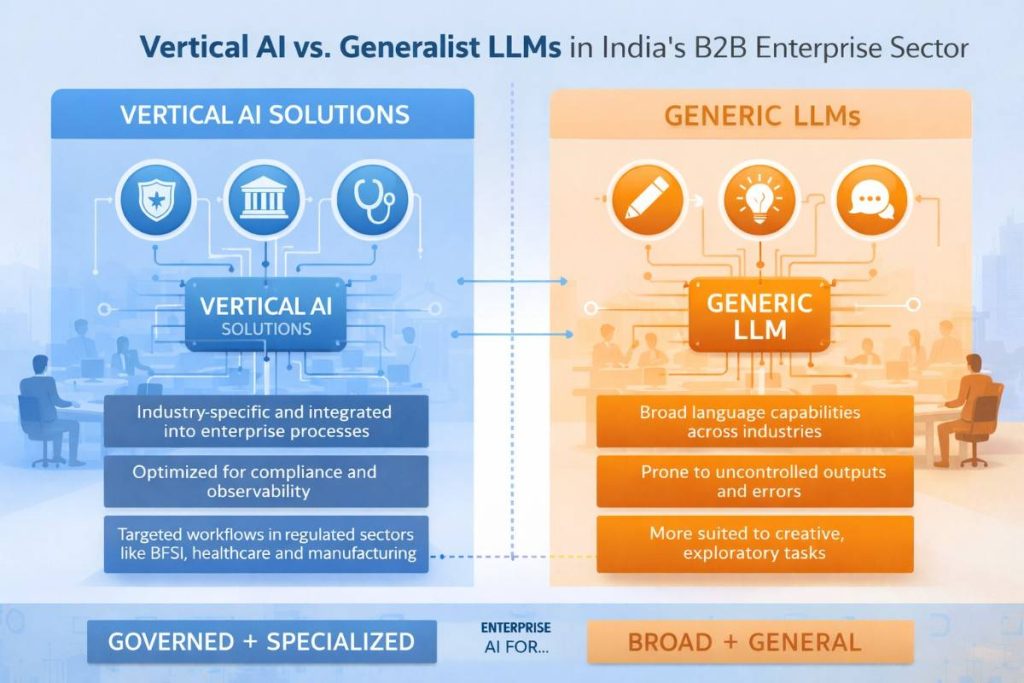
Integration with existing enterprise systems is another area where vertical AI has an edge. Indian enterprises typically operate on a mix of legacy platforms, customized workflows, and region-specific processes. Simply adding a conversational interface on top of this complexity rarely delivers sustained value. Vertical AI solutions are built to plug into systems of record such as ERP, CRM, core banking, or ticketing platforms, enabling AI outputs to flow directly into day-to-day operations. This ability to move from insight to action within established systems is a key differentiator in procurement decisions.
India’s IT services ecosystem has further accelerated this shift. Large service providers have increasingly positioned AI not as a standalone technology but as part of industry-aligned transformation programs. By combining domain expertise, process libraries, and managed services, they translate underlying model capabilities into deployable enterprise solutions. For buyers, this reduces execution risk and shortens time to value, reinforcing the appeal of vertical approaches.
The rise of so-called agentic AI has also sharpened enterprise focus on practicality. While autonomous agents promise efficiency gains, industry observers have cautioned that many such projects fail due to unclear objectives, governance gaps, or escalating costs. In response, enterprises are gravitating toward narrowly defined, task-specific agents embedded within vertical AI systems, where outcomes can be measured and controlled. Autonomy is welcomed only insofar as it improves reliability and efficiency without undermining accountability.
India’s enterprise environment amplifies these dynamics. A significant portion of economic activity is concentrated in sectors where compliance, documentation, and process discipline are non-negotiable. Decision-makers in these industries tend to prioritize solutions that can be audited, explained, and defended to regulators, customers, and internal stakeholders. Vertical AI aligns naturally with these expectations.
None of this suggests that generalist LLMs are losing relevance. They continue to play an important role as foundational technologies, supporting productivity tools, developer platforms, and knowledge management systems. However, in the competitive arena of B2B enterprise adoption, intelligence alone is no longer enough. What matters is dependable execution.
As Indian enterprises move deeper into the AI adoption curve, the market is signaling a clear preference. The future belongs less to models that can answer everything and more to systems that can do specific things well, consistently, and safely. Vertical AI is outpacing generalist LLMs in India not because it is more ambitious, but because it is better aligned with how enterprises actually work.
Also read : Strategic Rebranding: How Established Startup Founders Are Rebuilding Personal Authority After a Pivot
Add businessbyte.in as preferred source on google – Click here
Last Updated on: Thursday, February 5, 2026 10:59 am by Business Byte Team | Published by: Business Byte Team on Thursday, February 5, 2026 10:59 am | News Categories: Trending, Business
About Author