
In the startup world, pivots are no longer viewed as admissions of failure. They are increasingly understood as strategic responses to shifting markets, technological disruption, and evolving customer behavior. Yet while companies may survive or even thrive after a pivot, the personal brand of the founder often enters a period of uncertainty. Investors, employees, and customers who once associated a founder with a specific product, market, or narrative may struggle to recalibrate their perception. In response, a growing number of established startup founders are engaging in deliberate, carefully constructed personal rebranding efforts to rebuild authority and trust after a pivot.
This trend has become more visible over the past few years as startups navigate slower funding cycles, the normalization of shutdowns and acqui-hires, and the rapid rise of artificial intelligence reshaping entire business models. Founders who once derived credibility from high-growth metrics or media attention now face a different challenge: explaining not only what their company has become, but who they themselves are in this new context.
At the heart of this rebranding is a shift away from product-centric identity toward expertise-centric authority. Earlier startup narratives often positioned founders as visionaries tied closely to a single idea. When that idea no longer defines the company, the founder’s authority can erode unless it is reframed around deeper capabilities such as domain knowledge, systems thinking, or long-term pattern recognition within an industry. Many founders are now consciously repositioning themselves not as builders of one company, but as operators who understand how to navigate complexity, uncertainty, and change.
This approach reflects a broader evolution in how credibility is earned in the startup ecosystem. During the peak years of venture capital exuberance, authority was frequently inferred from fundraising milestones or rapid user growth. As capital has become more selective, investors and stakeholders are placing greater emphasis on judgment, resilience, and learning velocity. Founders who can articulate why a pivot was necessary, what was learned from the previous model, and how those lessons inform the new direction are increasingly seen as more credible than those who attempt to quietly distance themselves from past decisions.
Public communication has become a central tool in this process. Rather than relying solely on press coverage tied to product launches or funding announcements, founders are using long-form writing, interviews, and conference appearances to contextualize their journey. These narratives tend to be less celebratory and more reflective, focusing on trade-offs, miscalculations, and course corrections. This transparency aligns with the expectations of a more mature startup audience that includes experienced investors, seasoned operators, and employees who have lived through multiple market cycles.
Social platforms have also played a significant role, particularly professional networks where founders can directly address peers and stakeholders without mediation. By consistently sharing insights on market dynamics, leadership challenges, and operational decision-making, founders are rebuilding authority through demonstrated thinking rather than inherited hype. Importantly, this content is often decoupled from immediate company promotion, reinforcing the perception that the founder’s value extends beyond the current venture.
Another notable dimension of post-pivot rebranding is the recalibration of expertise. Founders whose original startups were framed around broad disruption narratives are increasingly narrowing their focus. Instead of presenting themselves as generalist entrepreneurs, they are emphasizing specific problem spaces such as enterprise workflow automation, financial infrastructure, climate technology supply chains, or developer tooling. This specificity helps anchor their authority in tangible experience, making their pivot appear as an evolution rather than a reinvention.
The internal audience matters as much as the external one. Employees who stay through a pivot often look to the founder for reassurance that the new direction is grounded in conviction rather than desperation. A coherent personal narrative, consistently communicated, can stabilize morale and reinforce alignment. Similarly, for founders seeking to raise capital again after a pivot, personal credibility often precedes belief in the new business model. Investors routinely assess whether a founder has internalized lessons from prior iterations and whether their leadership style has adapted accordingly.
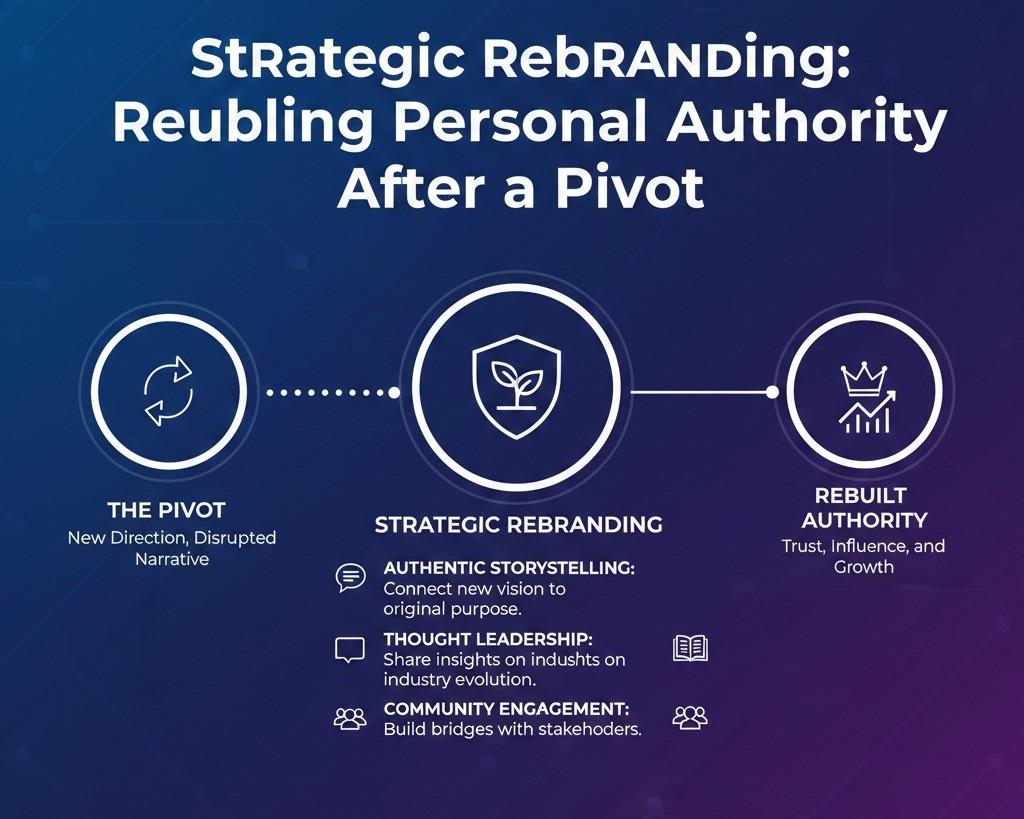
What distinguishes effective rebranding from superficial image management is continuity. Successful founders rarely attempt to erase their past. Instead, they integrate it into a broader story of progression. A failed go-to-market strategy becomes evidence of customer empathy gained the hard way. A shut-down product line becomes proof of discipline in capital allocation. By framing past outcomes as inputs rather than verdicts, founders reclaim authorship of their professional identity.
This emphasis on continuity also aligns with how long-term authority is built in other fields such as academia, policy, or industry leadership. Credibility accumulates through a visible body of work and a consistent intellectual stance, not through isolated wins. Startup founders who adopt this mindset are increasingly positioning themselves as durable contributors to their ecosystems, whether as repeat entrepreneurs, investors, or advisors.
The rise of strategic personal rebranding after pivots signals a maturation of startup culture itself. As the ecosystem moves away from binary success narratives, it is making room for more nuanced definitions of leadership and achievement. Founders are no longer expected to be infallible, but they are expected to be accountable, reflective, and clear-eyed about change.
In this environment, personal authority is less about clinging to a single story and more about demonstrating the capacity to evolve without losing coherence. For founders who can articulate not just where they are going, but how they think and why they adapt, a pivot does not diminish credibility. It becomes, instead, a cornerstone of it.
Add businessbyte.in as preferred source on google – Click here
Last Updated on: Wednesday, February 4, 2026 7:33 pm by Business Byte Team | Published by: Business Byte Team on Wednesday, February 4, 2026 7:33 pm | News Categories: Trending, Startups
About Author