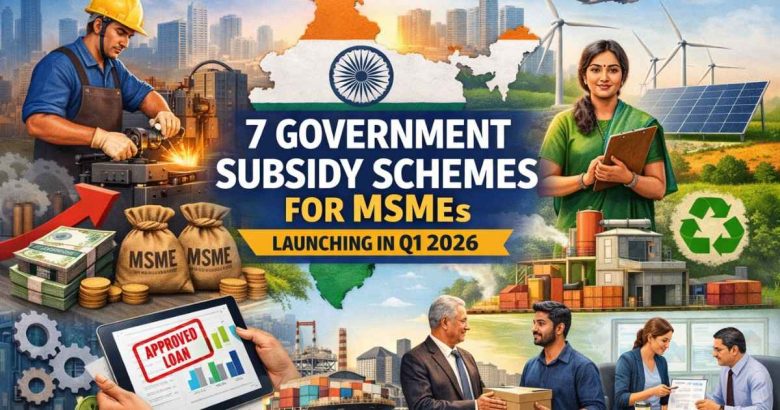
As India enters 2026 with a renewed focus on economic resilience and job creation, the government is preparing a fresh wave of subsidy and support schemes for micro, small and medium enterprises (MSMEs). Slated for rollout in the first quarter of the new financial year, these initiatives reflect a clear policy shift: moving beyond survival-focused credit relief towards growth-oriented capital, technology adoption and long-term competitiveness.
Together, the seven schemes expected to launch or formally activate in Q1 2026 aim to address some of the most persistent challenges faced by MSMEs, including access to affordable capital, delayed payments, outdated infrastructure, rising compliance costs and the pressure to adopt sustainable practices. For a sector that employs over 110 million Indians and contributes close to a third of the country’s GDP, the timing of these measures is critical.
At the centre of the 2026 push is a new MSME Growth Fund, designed to provide equity-linked financial support rather than traditional debt. Unlike loan-based subsidies, this fund is structured to help promising enterprises scale operations, invest in market expansion and strengthen balance sheets without the immediate burden of interest repayments. Policymakers see this as a turning point for growth-stage MSMEs that have historically struggled to access patient capital.
Complementing this is an expanded allocation for the Self-Reliant India Fund, with a sharper focus on micro enterprises and first-generation entrepreneurs. The enhanced fund is expected to channel risk capital into small units that lack collateral or long credit histories, enabling them to modernise machinery, digitise operations and stabilise cash flows. Officials involved in the programme describe it as a bridge between informal micro businesses and institutional finance.
Liquidity constraints, long regarded as one of the biggest pain points for MSMEs, are also being addressed through a strengthened trade receivables framework. From early 2026, the government plans to deepen reforms around invoice discounting and faster payment systems, particularly for MSMEs supplying to large corporates and public sector entities. By lowering the cost of receivables financing and improving payment discipline, this initiative effectively acts as an indirect subsidy, reducing reliance on high-interest short-term borrowing.
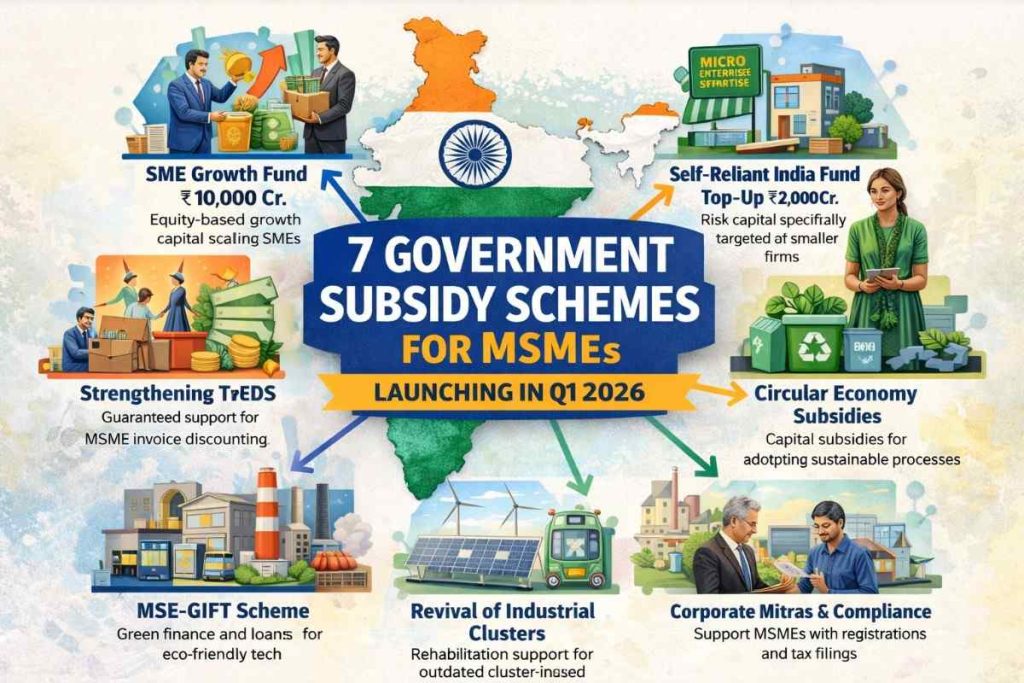
Sustainability has emerged as another major theme in the new policy cycle. Under the broader MSME reform architecture, a dedicated circular economy capital subsidy scheme is set to be operationalised in Q1 2026. This programme will support investments in recycling, waste-to-value processes and resource-efficient manufacturing, helping small businesses align with emerging environmental norms while lowering long-term operating costs.
Alongside this, a green transformation financing scheme is being readied to encourage MSMEs to adopt energy-efficient technologies and clean energy solutions. By combining interest support with partial risk coverage, the scheme is expected to make green investments commercially viable for small units that would otherwise defer such upgrades due to cost concerns. Policymakers view this as essential for integrating Indian MSMEs into global supply chains that increasingly prioritise sustainability credentials.
Another key intervention focuses on geography rather than finance alone. The government is preparing a large-scale revival programme for legacy industrial clusters that once formed the backbone of regional manufacturing economies. Through a mix of infrastructure grants, technology upgradation support and institutional hand-holding, the scheme aims to restore competitiveness in clusters affected by ageing facilities and declining productivity. Textiles, leather, engineering goods and traditional manufacturing hubs are expected to be among the primary beneficiaries.
Rounding out the Q1 2026 rollout is a compliance and capacity-building support initiative targeted at micro and small enterprises in Tier-II and Tier-III regions. Under this programme, trained professionals will assist businesses with registrations, tax filings and regulatory processes at subsidised or no cost. While not a direct financial payout, the initiative is expected to significantly reduce the hidden costs of compliance, freeing up time and resources for business growth.
Industry bodies have broadly welcomed the upcoming schemes, describing them as a more mature and balanced approach to MSME development. However, they have also cautioned that effective implementation, awareness and timely disbursal will determine real impact on the ground. Past experience suggests that many subsidies fail to reach their full potential due to procedural complexity or lack of outreach, especially among smaller enterprises.
As Q1 2026 approaches, MSME owners are being advised to ensure their registrations, financial records and project plans are in order. With a strong mix of equity support, capital subsidies, liquidity reforms and non-financial assistance, the upcoming policy package has the potential to reshape the MSME ecosystem. If executed as intended, it could mark a decisive shift from short-term relief to long-term resilience for India’s small business sector.
Add businessbyte.in as preferred source on google – Click Here
Last Updated on: Tuesday, February 3, 2026 6:52 pm by Business Byte Team | Published by: Business Byte Team on Tuesday, February 3, 2026 6:52 pm | News Categories: Trending
About Author